



Trigger warning: discussions of trauma, violence, and suicide
*This article contains spoilers for the game Clair Obscur: Expedition 33 and minor spoilers for the television show WandaVision
As any domestic violence survivor will tell you, the work doesn’t end once they’ve finally escaped the abusive situation they were trapped in. If anything, that’s when the real work begins. Healing from the trauma that domestic violence can inflict takes time, and it often requires the use of long-term therapy, trauma-informed support groups, and other mental health resources. The trauma can be even harder to overcome if the abuse started when the survivor was still at a young age.
The ways in which a person might react to their traumatic experiences make up a surprisingly broad spectrum of behaviors. In the case of domestic violence, it’s not uncommon for survivors to experience symptoms that mirror the post-traumatic stress disorder (or PTSD) that’s often associated with veterans of the armed forces. Given how painful the process of facing your traumas can be, it’s only natural that many people rely on coping mechanisms such as escapism to help them reestablish some sense of normalcy and control in their lives.
Escapism and the pain of facing your traumas head-on are prevalent themes in Clair Obscur: Expedition 33, a visually striking roleplaying game (or ‘RPG’) from developer Sandfall Interactive. Within its framework of interactive exploration, haunting music, inter-personal character dialogue, and turn-based combat, Clair Obscure shows how messy dealing with trauma can be, and how sometimes it’s ok to reach a conclusion where not everything is neatly solved.
A World Removed
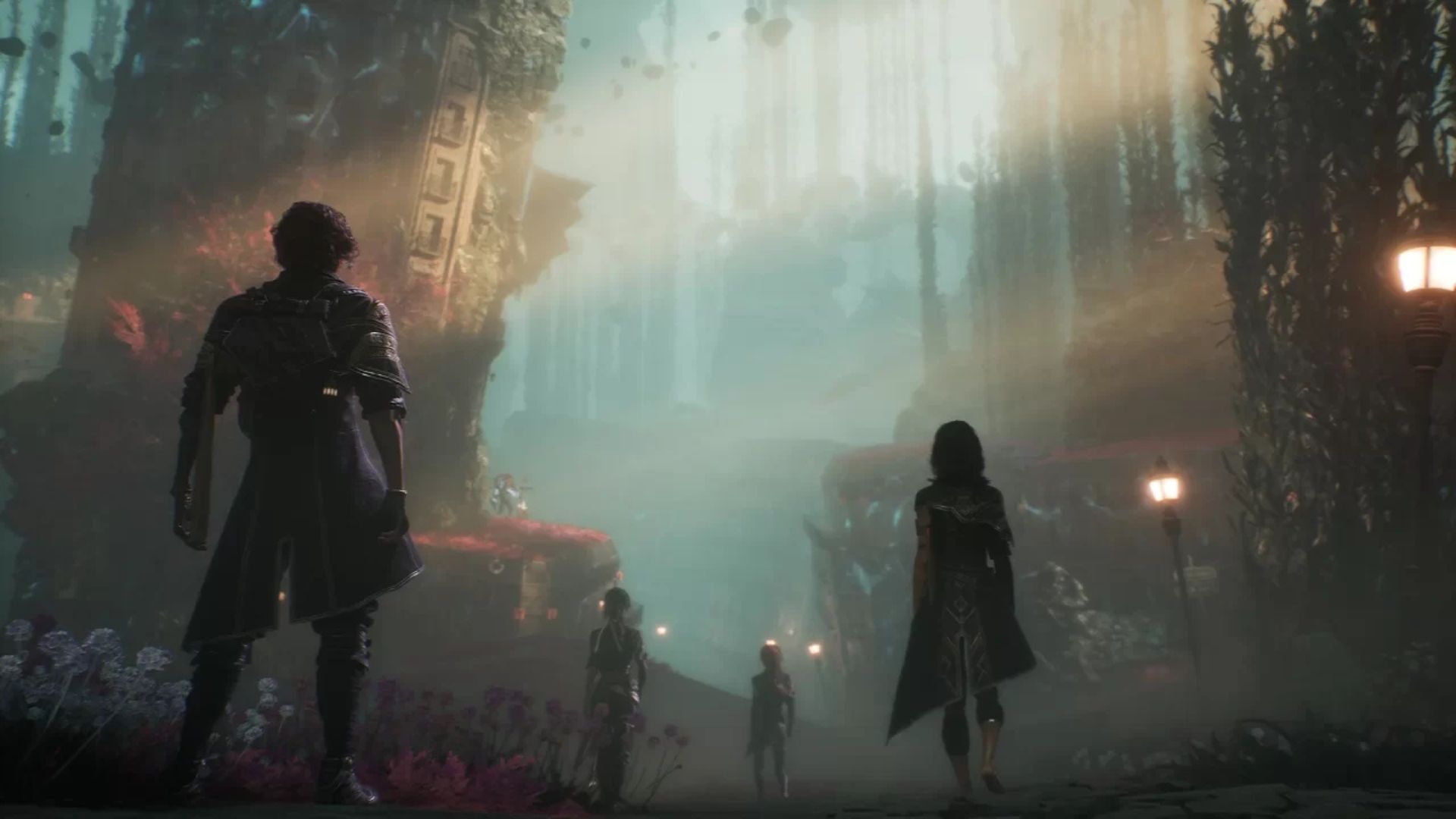
Clair Obscur transports players to a dark fantasy world that’s not too unlike our own, but which also borrows heavily from the Belle Epoque period of French history. The game starts in a city called Lumiere, where a young man named Gustave is spending some time with his teenage foster sister, Maelle.
Gustave, Maelle, and all the other citizens of Lumiere live in the shadow of a strange magical phenomenon called “the Gommage.” Each year, on the anniversary of the Gommage, an entity known as “The Paintress” paints an ever-decreasing number on a large tower situated far off across the ocean that separates Lumiere from the mainland. When the new number is painted, every person who is the same age as that number disappears forever. The game opens on the eve of the Gommage ticking down to the number 33, and Gustave, being 32 years old, knows he's about to lose several close friends, including his former girlfriend, a young woman named Sophie who recently turned 33.
Ever since the Gommage began roughly 67 years earlier, Lumiere has also sent out yearly expeditions to scout the fractured mainland and hopefully find a way to slay the Paintress and end the Gommage for good. After he’s forced to watch Sophie disappear, Gustave signs on with the latest expedition, Expedition 33, along with Maelle (who insists on accompanying him even though she has many more years before her own Gommage). Several of Gustav’s friends also volunteer for Expedition 33, including Lune (a scholar and elemental magic user) and Sciel (a skilled and boisterous warrior who uses fate-based magic).
Shortly after Expedition 33 arrives on the shore of the mainland, they encounter a mysterious old man who commands an army of monsters and wields powerful dark magic. The old man and his monstrous cohorts easily wipe out a large portion of Expedition 33 in a sudden and horrific attack on the beachhead, with Gustave, Maelle, Lune, and Sciel being the only survivors. The scattered foursome eventually manages to regroup and resume their quest to slay The Paintress, and along the way they encounter a series of bizarre phenomenon, including a large empty manor which apparently exists in a separate dimension outside of their own.
Painful Truths
As the group continues their journey across the fractured world, Maelle is plagued by visions and nightmares of both the old man who attacked them on the beach, and of a young woman with white hair, burn marks on her skin, and a mask covering her face. The old man and the white-haired woman seem to know Maelle somehow, but little else is revealed other than that an unknown disaster befell them, and that Maelle was involved in some capacity (though she doesn’t remember how exactly).
After a pivotal battle a little way further into the game (a “boss fight” in gamers’ parlance), the old man ambushes the party again, mortally wounding Gustave, who desperately fights the old man to protect Maelle. After Gustave dies and it looks as if the old man will kill Maelle next, Maelle is saved at the last minute by yet another mysterious stranger, a man named Verso who clearly has some bad blood with the old man.
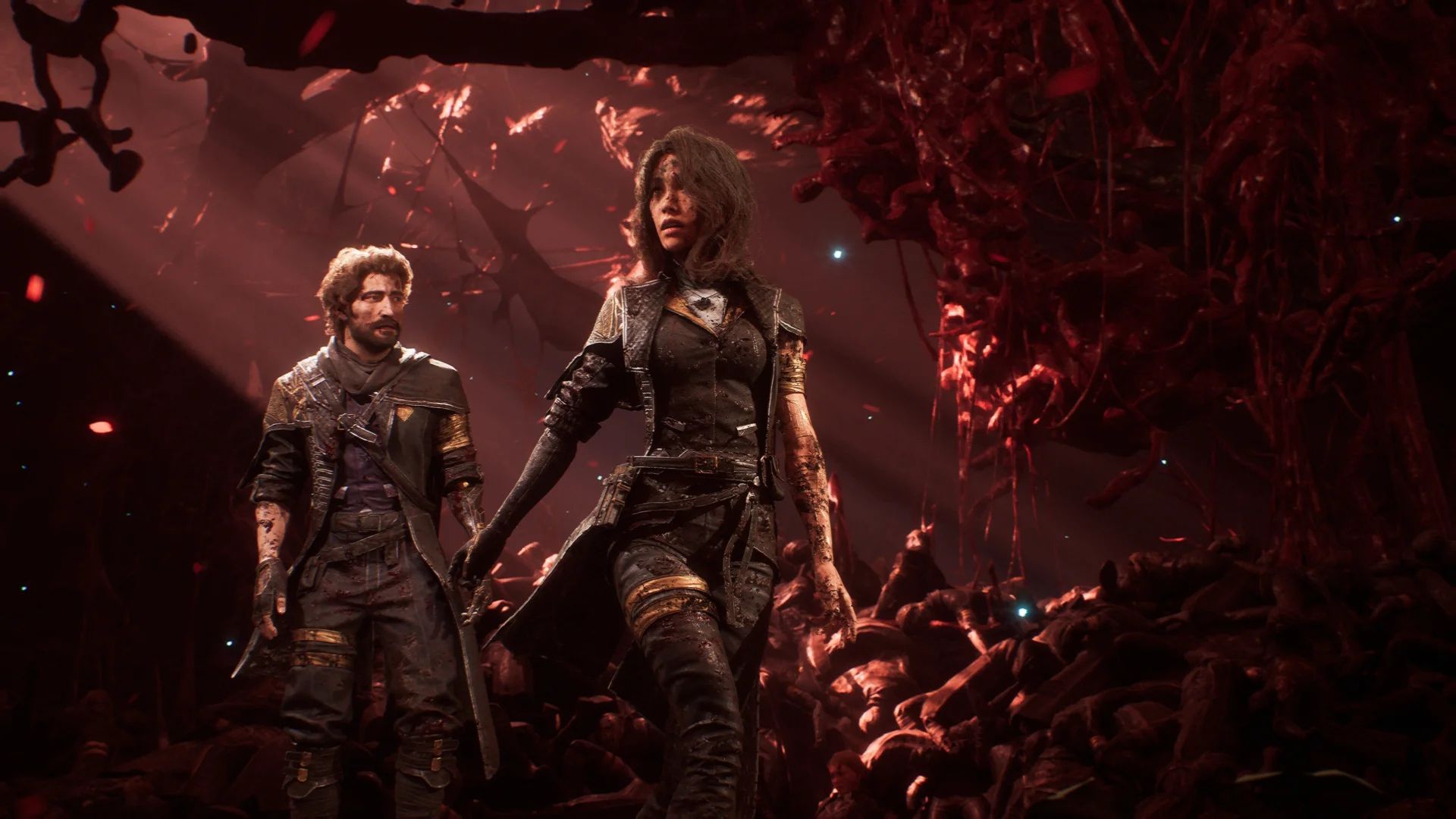
Verso helps Maelle and the others escape, eventually revealing that he and the old man (whose name Verso says is Renoir) were part of the very first expedition from over sixty years ago. According to Verso, close proximity to The Paintress caused him and Renoir to stop aging, and now Renoir is fiercely defending The Paintress to protect his immortality. Verso, meanwhile, has grown tired of the constant cycle of seeing new expeditioners arrive each year only for Renoir to callously slay them. He agrees to help the others fulfill their mission to slay The Paintress so that he too can finally die and find peace, and to help Maelle slay Renoir to avenge Gustave.
As the player might already suspect after recruiting Verso and resuming their journey across Clair Obscur, Verso and Renoir both have many additional secrets to reveal, some of which are unknown even to them. This Clair Obscur story breakdown from Acer Corner’s Patrick Yu dives deep into the truly dizzying narrative that Sandfall built for the game, but for the sake of expediency, here’s a summary of the major revelations from the game’s second half:
- Verso eventually discloses that Renoir is his father, the white-haired woman with the mask is his sister Alicia, and The Paintress was once his mother, Aline. The inter-dimensional manor the group found after Renoir’s beach attack is a remnant of Verso’s own home he once shared with the rest of his family.
- When the group finally manages to slay Renoir and then The Paintress, they return to Lumiere and receive a hero’s welcome. But a letter that Alicia gave to Verso reveals that The Paintress was *forestalling* the Gommage, not causing it, and moments later everyone in Lumiere is taken by the Gommage all at once.
- A flashback reveals that Alicia, Verso, Aline, and Renoir (along with Verso and Alicia’s sister, Clea) are members of the Dessendre family, a family of magically gifted painters living in an alternate version of early 20th century Paris. Their magic essentially allows them to paint canvases which they can then enter and inhabit (though staying in a canvas for too long causes the painter to lose their grip on reality).
- A house fire that Alicia inadvertently caused after a rival guild manipulated her claimed Verso’s life, and left Alicia horrendously scarred and unable to speak. In her grief, Aline retreated into a canvas that Verso had painted as a child (the same canvas world the player has been exploring up to this point), creating ‘painted’ copies of all her family members (including Verso) so that she could continue living in a world where her son was still alive and her family was still whole.
- Renoir attempted to enter the canvas so he could pull Aline back into the real world and help her face her grief, but Aline’s refusal to accept reality led to a clash that left the painted canvas world fractured, and trapped Renoir within the tower Aline was inhabiting. In the “present,” Renoir’s continuous attempts to erase the canvas world by force are stymied by Aline’s fierce desire to preserve the memory of her dead son, resulting in the Gommage (the yearly countdown representing Renoir’s slow overtaking of Aline’s dwindling magic).
- Clea sends Alicia into the canvas to try and break the stalemate between their parents, but Alicia is quickly overwhelmed by Aline’s magic and Aline, not wanting to kill her own daughter, “repaints” Alicia into a version of herself who isn’t disfigured and who can still talk. This repainted version of Alicia is soon revealed to be Maelle, who had lost her memories as part of the process and was thus adopted by Gustave and his family.
- Not only is the entire world of Clair Obscur revealed to just be a magical painting, the same is true for all the game’s characters who aren’t members of the Dessendre family. In addition to the “painted” versions of the Dessendre family that Aline created, characters such as Gustave, Sophie, Lune, and Sciel aren’t real either. They’re just paintings who were added to Verso’s canvas over time.
The Losses We Live With
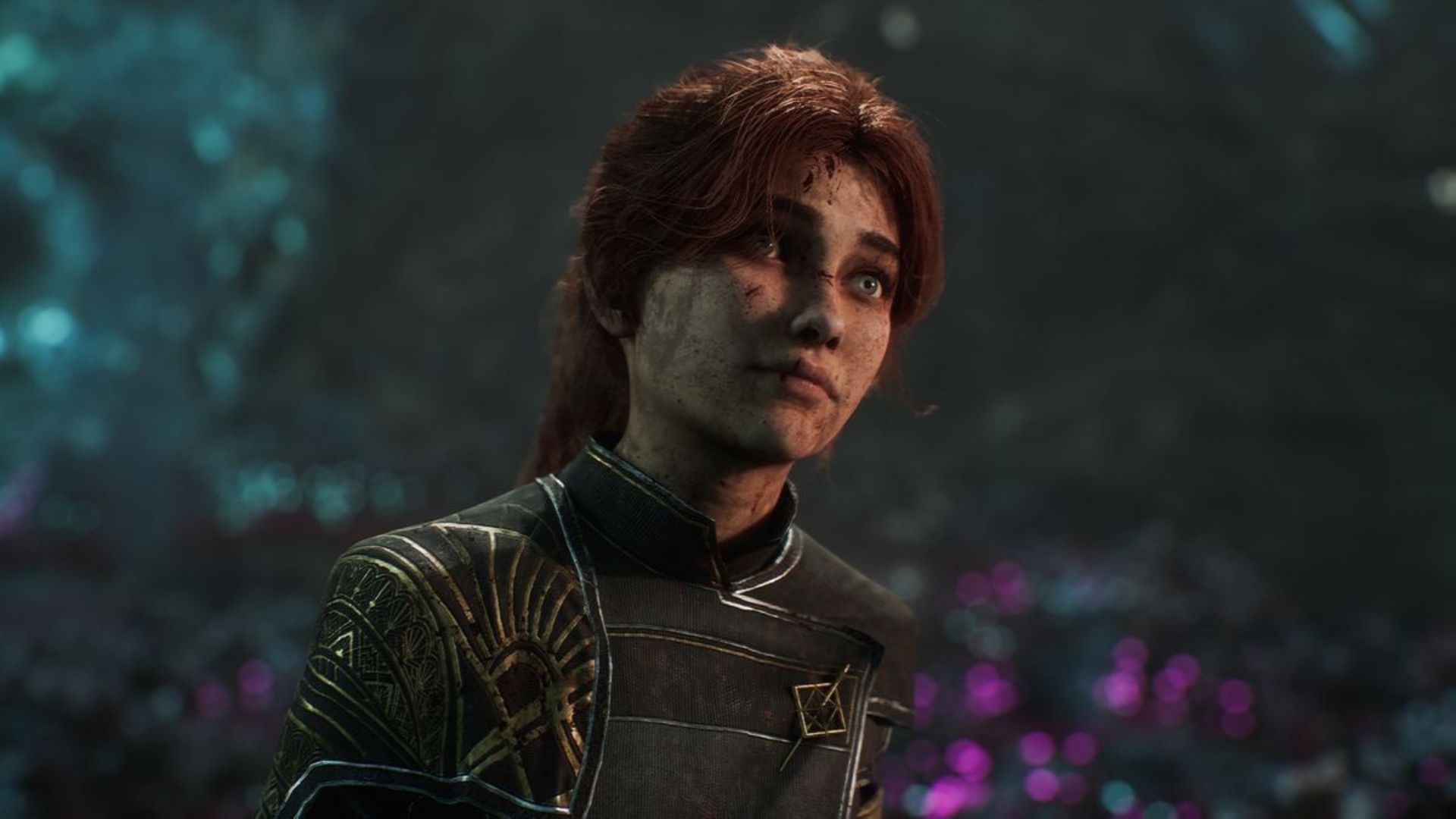
Maelle’s “death” after the Gommage claims everyone in Lumiere has the unintended side-effect of restoring her with all of Alicia’s memories, thus allowing her to “paint” as The Paintress once did. Her restored painter abilities enable her to revive Lune, Sciel, and her other party members, and they all soon reunite with Verso. Alicia, not wanting to return to the “real” world where she’s still disfigured, finds herself locked in a new battle with her father, the *real* Renoir who was finally freed from his tower prison after The Paintress’s death (the Renoir they killed earlier was the painted version).
This new conflict between Alicia (formerly Maelle) and Renoir not only sets the stage for the game’s climax, it also drives home the cyclical nature of grief and trauma as the player sees how they affect not only Aline, but Alicia as well. It was only natural that Maelle would bond so deeply with Gustave, since he was a surrogate for the brother she hadn’t even realized she’d lost. Then, by the time Maelle is restored as Alicia, she’s already started to bond with a painted version of the man who actually *was* her brother.
The reality of losing Verso, losing Gustave, and then potentially losing Verso *again* if Renoir finally manages to destroy the canvas is too much for Alicia to bear. This idea is further explored in Hayes Madsen’s excellent Inverse retrospective in which he uses Clair Obscur to examine his own conflicted feelings over the death of his brother by suicide:
“As we learn later, Verso is the painted version of Maelle’s (Alicia’s) real-life brother, who passed away in a tragic fire. Gustave filled that role of elder brother that Verso had been, giving Maelle a stopgap for her grief. But over time, Gustave’s relationship with Maelle turned into something much different. We then see that again when Verso joins the party — he’s Gustave, but a little different. His relationship with the party is different, and his combat style is similar but subtly changed. He’s not Gustave, and he never will be.
What we see here is a cyclical experience of grief, with Alicia trying to fill the void left by the original Verso. But the truth is that you never can fill that void, no matter how hard you try. You’ll find other people you care about, others who can feel like siblings, but it’ll never be the same. Maelle grows to love the painted version of Verso, but in a different way.”
Throughout most of the game, Maelle is presented as one of the heroes while Renoir is clearly a villain, but nearly the opposite is true once the end is finally in sight. Renoir, for all the harm and trauma he inflicted on the painted citizens of Lumiere through the Gommage, only ever wanted to rescue his wife Aline from the prison of her own grief. Alicia, meanwhile, is so terrified of losing her brother (again) and of having to abandon an entire world full of people she cares about, that she’s willing to fight her own father to preserve the delusion her mother started.
It doesn’t matter that the painted version of Verso Alicia’s been journeying with isn’t real. It doesn’t matter that Gustave wasn’t real. Now that Alicia finally has the opportunity and means to keep some semblance of her brother alive, and to potentially bring her dead friends back if she so chooses, she’s naturally reluctant to give up that opportunity. Given everything Alicia’s been through and everything she’s lost up to this point, it’s hard to blame her.
Or it *would* be hard to blame her if not for the desire painted Verso expressed earlier to finally be granted the peace of death (a desire which Verso later makes clear was genuine). It’s in Clair Obscur’s final climactic duel, where the player must choose between siding with Verso or siding with Alicia, that Sandfall reveals its messiest lesson of all: it’s impossible to keep the pain of our personal traumas from hurting those we care about the most.
Depending on which side the player chooses, Clair Obscur can have one of two very distinct endings:
- Siding with Alicia grants her the power to restore Lumiere and everyone who was ever taken by the Gommage, including Gustave and Sophie. However, Alicia’s choice to keep living in the painted world means she will eventually succumb to the same break from reality that her mother did, and that Verso is doomed to spend eternity pantomiming for Alicia’s benefit since she’ll never give him the death he craves.
- Siding with Verso enables him to complete Renoir’s goal of destroying the canvas (and by extension himself), ending the Gommage and allowing Renoir, Aline, and Alicia to return to the real world. Everyone from the painted world is erased forever, but in the real world the Dessendre family is finally able to mourn Verso, reconcile, and begin the process of healing from their shared trauma.
It can be tempting to frame Alicia’s ending as the “bad” ending and Verso’s as the “good” ending, but the point that Sandfall is trying to make is that it’s all a matter of perspective. When dealing with trauma, there’s really no such thing as a truly good ending. There will always be pain, there will always be loss, there will always be that melancholic realization that the best you can do is take something that was broken and try as hard as you can to cobble it back together.
Hayes Madsen explains in his Inverse essay how, from a certain point of view, many people who have faced the trauma of losing a loved one would see Alicia’s ending as the more desirable outcome:
“There’s not a “good” ending here, and there’s not supposed to be. Grief is messy and shapes us in ways we don’t often like, but can’t deny. If I had the chance to try and bring a version of my brother back to life, would I? As much as I might want to say no, deep down, I can’t be sure of what answer I’d give if given the same choice as Maelle.”
Game critic and journalist Maddy Myers also notes in this piece comparing Clair Obscur to the hit Disney/Marvel show WandaVision that, from a certain perspective, Verso’s ending could contain just as much bad as good:
“In the ending where Maelle leaves the painting, we’re treated to cutscenes in which our main cast of characters evaporate into thin air as the canvas on which they live gets destroyed for good. Verso may have begged for death, but these other characters all wanted to live—and are their lives real, or not? It’s an open question.
In WandaVision, the answer to this question is far more obvious. The brainwashed people acting out Wanda’s fantasy were definitely real, and torturing them was wrong, full stop. But in Clair Obscur, the ethics are a bit harder to parse. By choosing the ending where Maelle returns to her world, it feels like I—the player—killed off Gustave, Sciel, Lune, Monoco, and Esquie. And unlike many video games with poor character writing, these characters do feel like actual people. It feels bad to watch them disappear.”
Making Peace in our Own Way
In at least some regard, Clair Obscur makes plain the dangers of letting healthy avoidance spill over into toxic escapism. However, as any survivor of domestic violence likely knows already, recovering from trauma is neither straightforward nor easy. It’s only natural to be tempted by anything that can immediately soothe the acute pain that trauma inflicts, even if we know deep down that such relief often comes at the cost of true long-term healing.
The underlying message of Clair Obscur isn’t simply that “escapism is bad.” It’s that everyone processes trauma and grief in their own ways, and yes, sometimes those ways can be harmful or unproductive. Does that make the person trying to deal with their trauma bad? Of course not. It makes them human.
The journey to healing can have many twists, turns, roadblocks, and false starts, but it’s never a bad thing to try and undertake the journey in the first place. The characters of Clair Obscur may not be real (in more ways than one), but that doesn’t make the lessons they impart about grief, acceptance, and the human need for closure (in ways both healthy and not) any less impactful.
