



*Content/trigger warning: The game discussed in this blog post includes themes and imagery that some readers might find upsetting. There is also a mention of suicide.
REACH’s mission as a support agency for survivors of domestic violence has always involved a two-pronged approach: advocating for survivors after the abuse has occurred, and educating communities to help prevent future cases of abuse.
We can classify the different kinds of abuse a survivor might experience, but the trickier issue to address is why a person might knowingly choose to abuse someone they claim to care about. The unfortunate answer to that question is often that the abuser was raised in an environment where abuse was normalized, creating an insidious feedback loop where they adopt the same abusive behaviors they were exposed to.
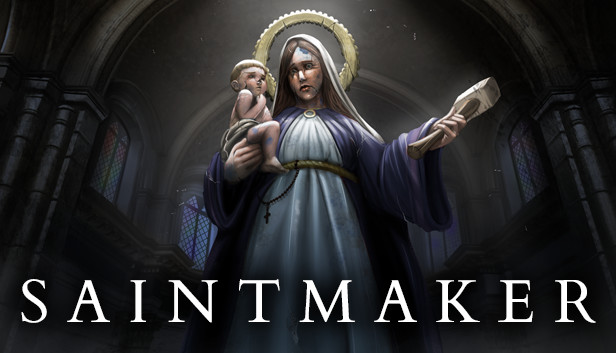
This idea of “normalized abuse” sits at the heart of Saint Maker, a visual novel-style horror game developed and published by Philippines-based game developer Yangyang Mobile in 2023.
The game’s focus on religious themes is evident from its title alone, but Saint Maker isn’t meant to be a sweeping condemnation of religious institutions or practices. Rather, it’s an exploration of how seemingly noble intentions can be used to justify the abusive practices that keep survivors trapped in harmful cycles of control.
Conformity and Conflict
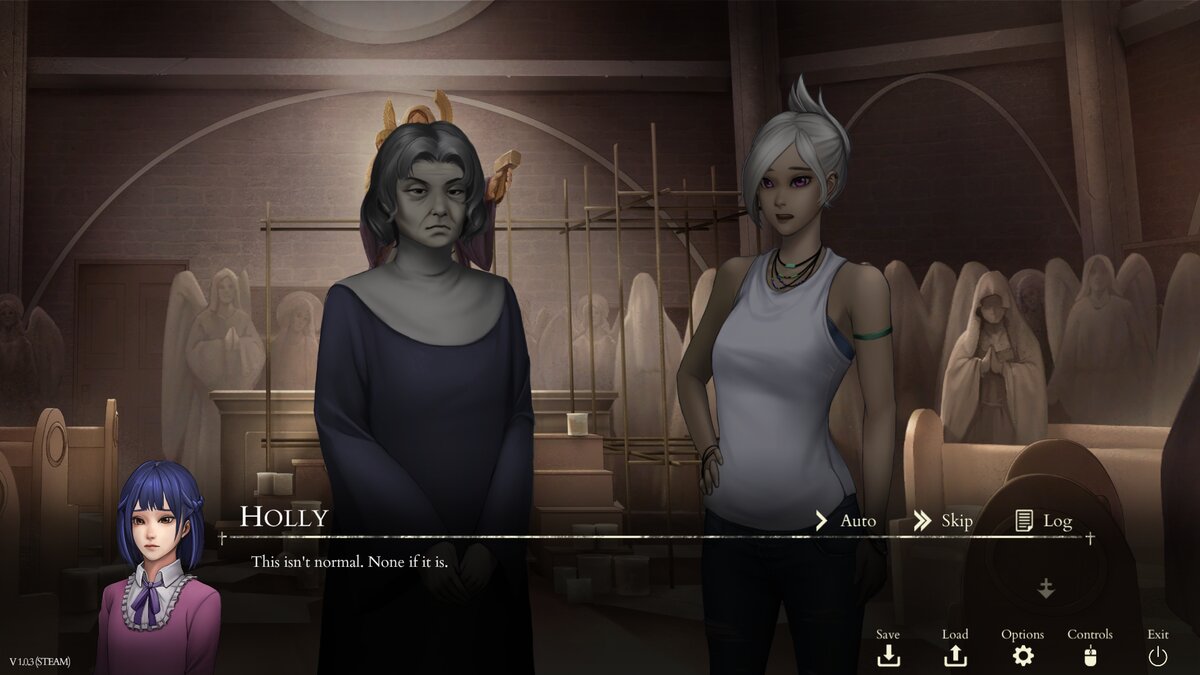
Saint Maker opens with protagonist Holly Beltran, a timid and introverted teenage girl who was raised in a strictly religious household by her abusive mother, arriving at Saint Idelora’s convent for Recollection and Reformation, a remote monastery largely sequestered from the rest of the world.
Upon her arrival, Holly meets Sister Adira, the convent’s taciturn head nun who introduces Holly to Gabriella “Gabby” Rivera, another teenage girl. As Sister Adira explains, Holly and Gabby have been sent to Saint Idelora’s by their parents so that she can reform them into the sort of upstanding young women their parents would be proud of.
Holly does her best to keep an open mind about what she anticipates will be a strict and unpleasant series of lessons, but Gabby takes the exact opposite approach, challenging Sister Adira and refusing to accept this fate that her mother has decided for her. Sister Adira remains composed in the face of Gabby’s verbal resistance, confident that she knows what’s best for these two young women she’s only just met.
Through dialogue choices made by the player, Holly can placate Sister Adira’s initial doubts about Holly’s willingness to embrace the planned reformation, and even find some common ground with the older woman. However, no matter how much the player manages to “say the right things,” Sister Adira still makes it clear that she expects Holly to conform without question.
The Pain that Haunts Us
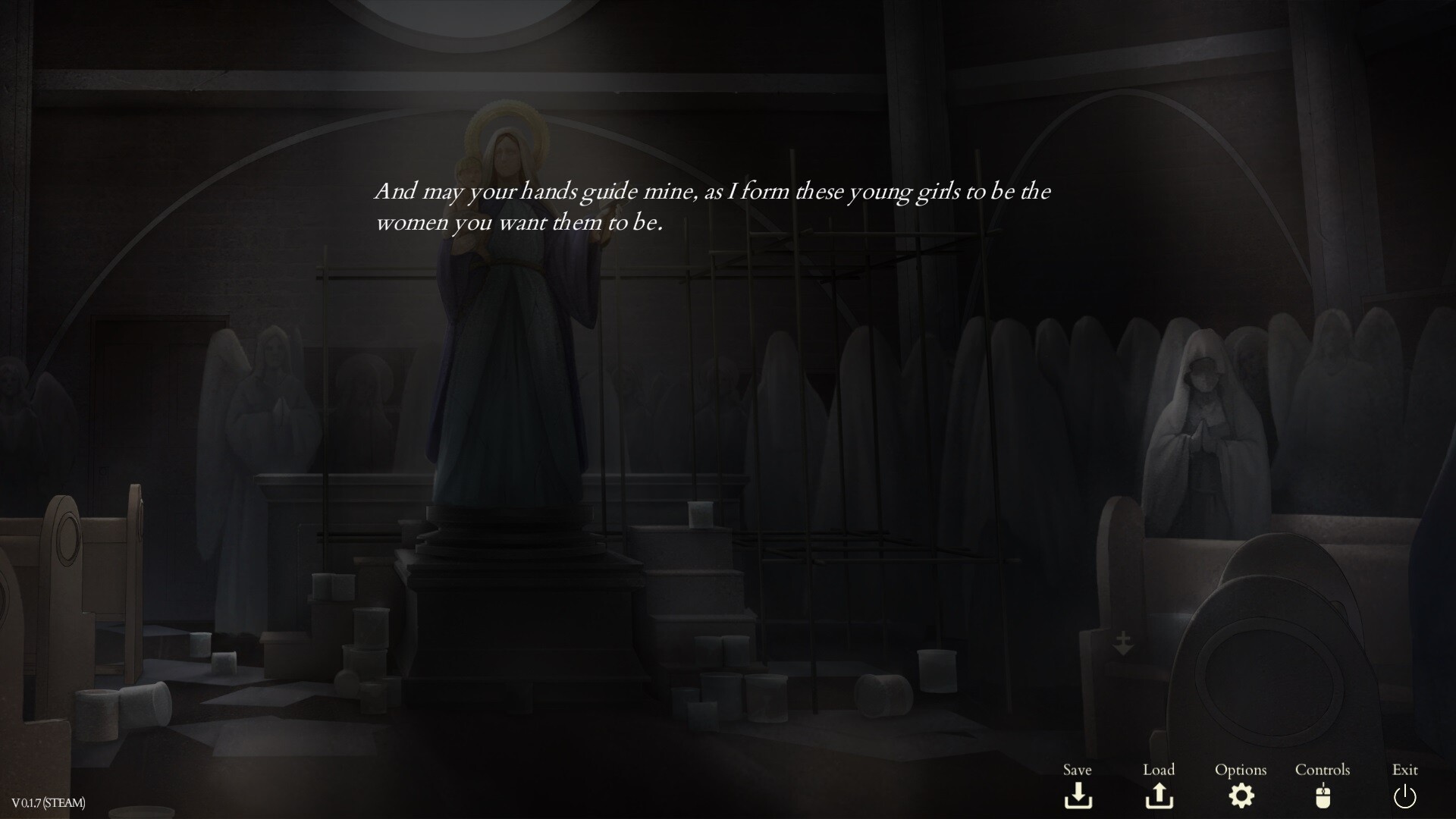
Since Saint Maker is a horror game, it isn’t long before the narrative veers into the realm of the spooky and supernatural. At night, Holly has disturbing dreams and visions involving the statues that occupy the monastery grounds, and she suspects they are somehow connected to her younger sister Liana, who died shortly before Holly was sent away to Saint Idelora’s.
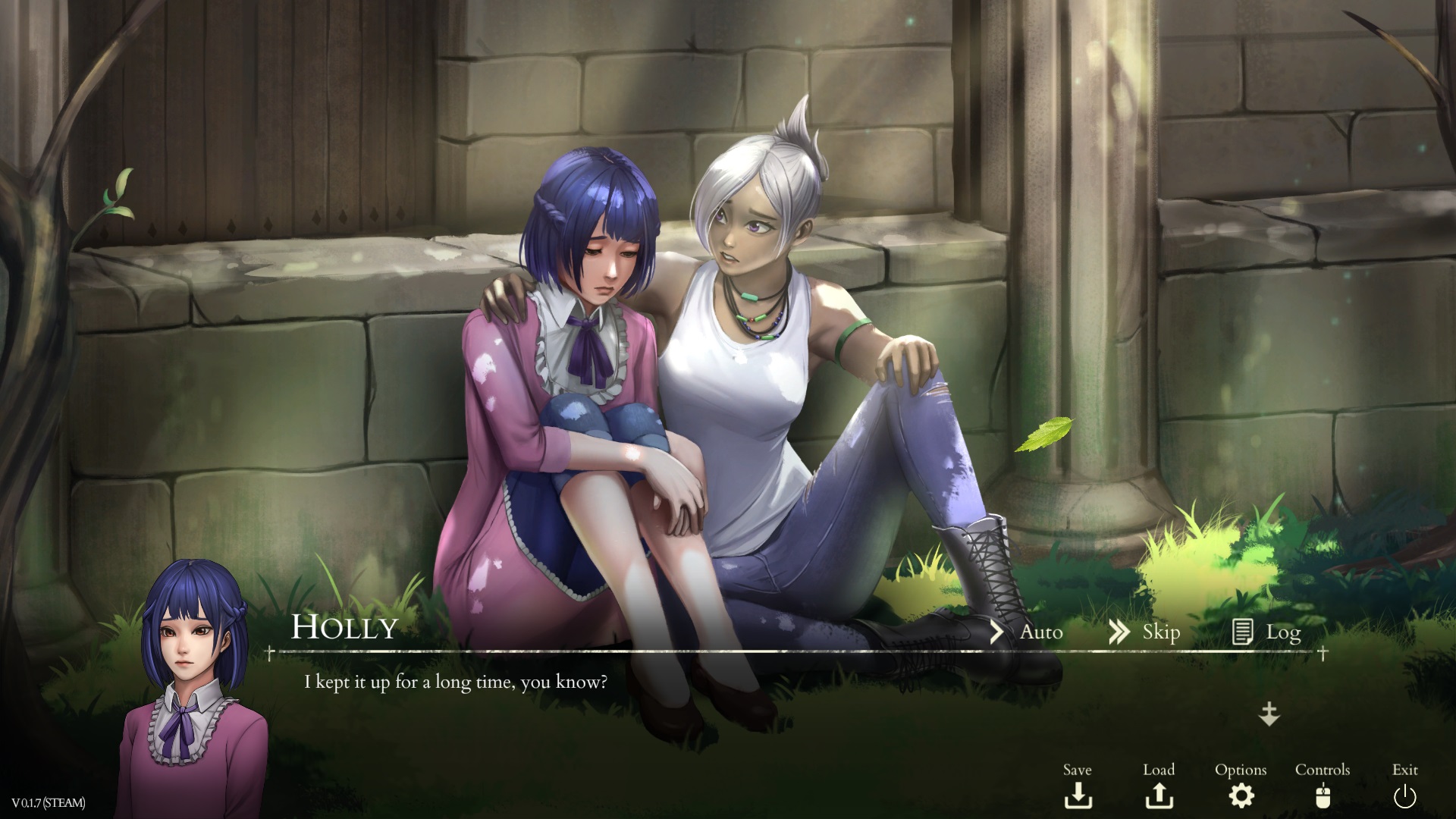
While Gabby is initially distrustful of Holly and her efforts to please Sister Adira, the two soon start to bond over their shared trauma of having been raised by abusive parents. Gabby explains that her once pleasant and kind mother found solace in religion after her father died, becoming colder and more distant as she expected Gabby to obey her without question. When Gabby confessed her romantic feelings for another girl (a sinful taboo in the eyes of her mother), she was shipped off to Saint Idelora’s much like Holly.
Over time, Holly and Gabby fall into a routine of following Sister Adira’s schedule by day and investigating the cause of Holly’s hauntings by night. Sister Adira, interpreting Holly and Gabby’s suspicious behavior as further proof of their moral failings, becomes increasingly convinced that only she knows what’s best for them, and her behavior becomes steadily more controlling and abusive as a result.
Breaking the Cycle
Through both their personal discoveries made while exploring the convent grounds as well as lectures given by Sister Adira, Holly and Gabby slowly piece together the history behind the convent’s namesake, Saint Idelora. They learn that the statues spread around the convent are of former nuns who were “sainted” much as Idelora herself was, and that the teachings Saint Idelora instilled in her followers noticeably deviated from those in the traditional bible.
Meanwhile, Holly’s mental health continues to deteriorate as she’s haunted both by nightmarish visions of the convent’s statues and memories of when she and her sister found solace from their mother’s abuse by secretly reading fantasy books together.
In her initial recollections, Holly comforts and commiserates with Liana, but the hauntings force her to eventually confront the truth: that she was dismissive of Liana’s pain and even blamed Liana for angering their mother so often. Liana, feeling isolated and overwhelmed, ended up committing suicide, and the guilt that Holly felt over Liana’s death was so crippling that she chose to repress it rather than accept it.
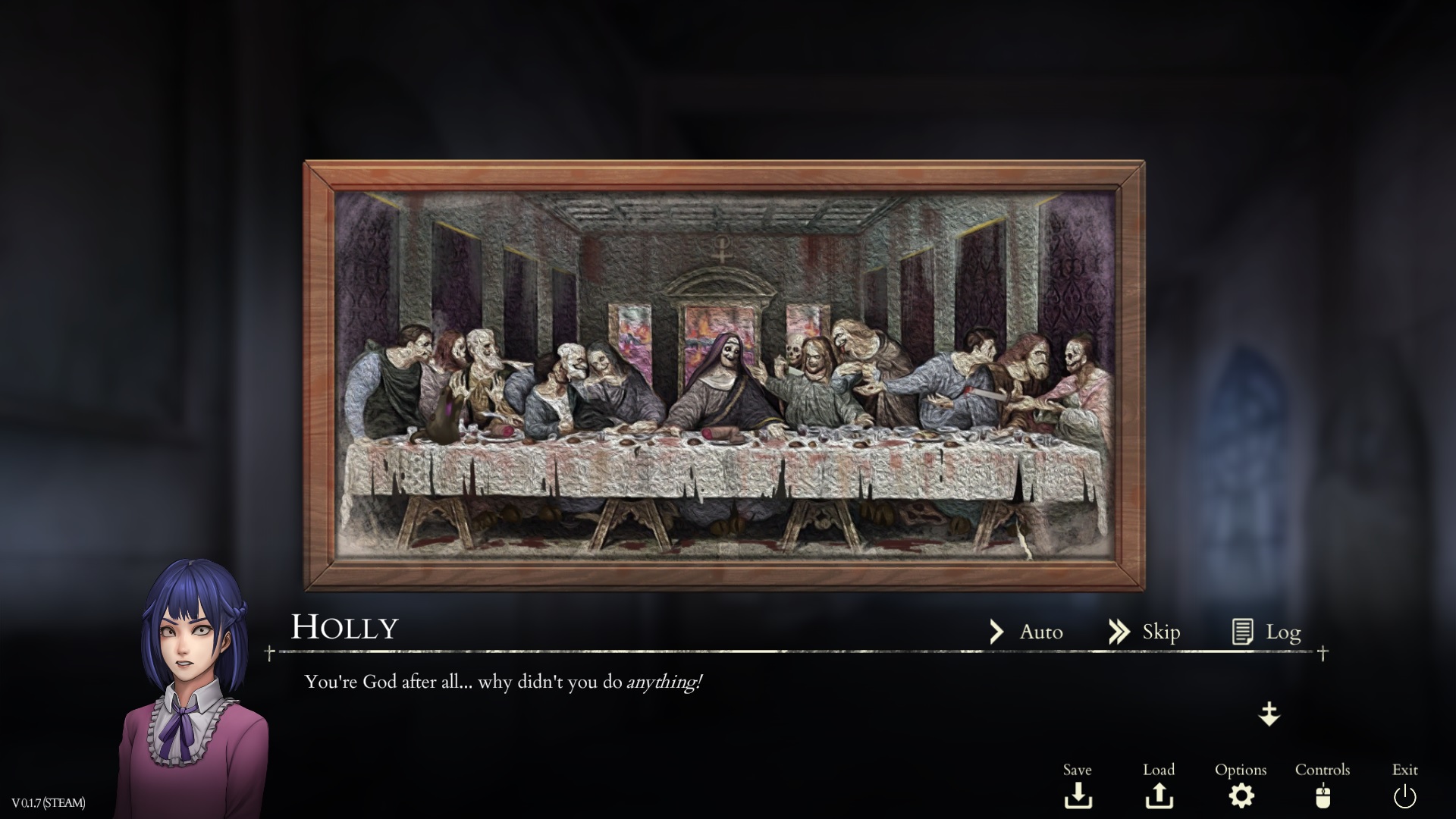
Throughout her stay at Saint Idelora’s, Holly has occasional run-ins with a younger nun who seems kind and compassionate, but who is also scolded by a group of older, crueler nuns for questioning Saint Idelora’s teachings. In one of her visions, Holly glimpses into the past and witnesses a moment where the younger nun comforted a small orphan girl named Cornelia, and she watches in horror as the younger nun tries and fails to stop the other nuns from taking Cornelia away at Saint Idelora insistence.
Holly learns in this vision that the convent of Saint Idelora had adopted a practice of taking any pupils who refused to conform to the nuns’ controlling and abusive practices and burying them alive in stone sarcophagi. The young nun is revealed to be a younger version of Sister Adira; with the guilt she feels over abandoning Cornelia manifesting as a near-fanatical devotion to Saint Idelora’s teachings (i.e. reforming other young women so they are spared Cornelia’s fate).
When Holly tries to confront Sister Adira about what she saw, Sister Adira seals her in one of the stone sarcophagi, believing it’s the only way to “save” Holly from herself. While she’s trapped in the sarcophagus, Holly has another vision with Cornelia’s ghost where Cornelia helps Holly confront her guilt over Liana’s death. Cornelia sees Holly as the kind soul that Sister Adira used to be, and Holly realizes that refusing to face her guilt will only ensure she ends up no different than her mother or Sister Adira.
Gabby eventually frees Holly from her tomb, and when Sister Adira tries to stop them from leaving the ensuing scuffle knocks over a lit candelabra, starting a fire that forces all three of them to escape the burning building. After escaping, Sister Adira desperately tries to get back inside, convinced that the statues she watched over for so long are actual people (and revealing that she systematically sealed her fellow nuns in the stone crypts until she was the only one left).
Holly and Gabby realize that the other nuns they encountered during their stay were in fact ghosts from the past, and it isn’t until Cornelia’s ghost appears that Sister Adira’s fanatical devotion to Saint Idelora is finally broken. Cornelia invites Sister Adira to rebuild the convent for a more noble purpose, and Holly and Gabby escape to the nearby woods, where Holly decides that the best thing is for her to not return to the house she shared with her parents and Liana.
Gabby, relieved to see that Holly is ready to move past the guilt and pain her religious upbringing kept her trapped in, invites Holly to come stay with her, saying that she hopes Holly’s presence will help her own mother remember the kind, warm, and funny woman she used to be before Gabby’s father passed away.
The Realities of Spiritual Abuse
Saint Maker tells a compelling story, one that’s bolstered by lush visuals, sharp writing, and a charged performance from the game’s voice cast. However, as with the other games we’ve covered through our ‘Gaming for Good’ blog series, it’s important to remember that the game is still a work of fiction.
Also, much like certain movies that touch on themes of coercive control and abuse, Saint Maker simplifies what are, in reality, very complex issues that cannot be resolved in a two-hour runtime. Unlike Sister Adira, abusers typically don’t have a sudden change of heart or “see the error of their ways” after a single major event. Similarly, unlike Holly, survivors usually need more than a week-long stay at a remote convent to fully recover from their trauma.
Still, despite how much it streamlines and papers over the complex dynamics between abusers and survivors, Saint Maker still offers an important perspective into how an abusive mindset can be passed down from one generation to the next.
Sister Adira couldn’t control the fate that befell Cornelia, so it makes sense that she would cling so tightly to the idea that she *can* control the fates of the young women who are placed under her charge. While the player never actually sees Holly’s and Gabby’s mothers, it’s not hard to imagine how the tragedies they suffered (and the environments they were likely raised in) would lead them to adopt a “my way is the best way” approach with their daughters.
Throughout its entire narrative, Saint Maker is careful to frame religion not as the source of the abuse being inflicted on Holly, Gabby, Liana, Cornelia, and younger Sister Adira, but rather the justification for why it’s being inflicted.
When we discuss “religious abuse” or “spiritual abuse” in the context of domestic violence, it’s usually because the abuser is preventing their partner or loved one from participating in their faith. However, it’s not unheard of for abuse to manifest in the opposite manner, i.e. as forced participation (as is the case with Holly, Liana, and Gabby). It’s also very much not unheard of for religion to be used as a smokescreen for controlling/abusive behavior (as with how the nuns treat Cornelia and younger Sister Adira).
Healing Through Support
In a 2022 interview with VN Game Den, Saint Maker’s lead writer Carlos Valdez explained how religious imagery inspired not only the game’s visuals, but also its themes of trauma and abuse:
“Horror involving religious imagery has always been fascinating for us — there’s just something terrifying when what we’ve come to associate with the divine is twisted into something dangerous and evil.
Some members of the team have come from a Catholic background, and though there’s good that can come from religion, there’s a lot of trauma and abuse that our generation has endured by people who use it as a means to control and abuse others.”
While its horror-adjacent themes are simplified to a certain degree for the sake of its audience, Saint Maker’s underlying messaging is delivered more subtly.
Holly is able to process her grief over losing Liana and accept what she can’t change about her past or her mother, but she doesn’t do so alone. Gabby and Cornelia both help Holly in their own ways, whether by listening to her or by giving her the space to confront her proverbial demons once she’s ready. Survivors must work through their trauma to heal from it, but the support of others is very much a vital part of that healing.
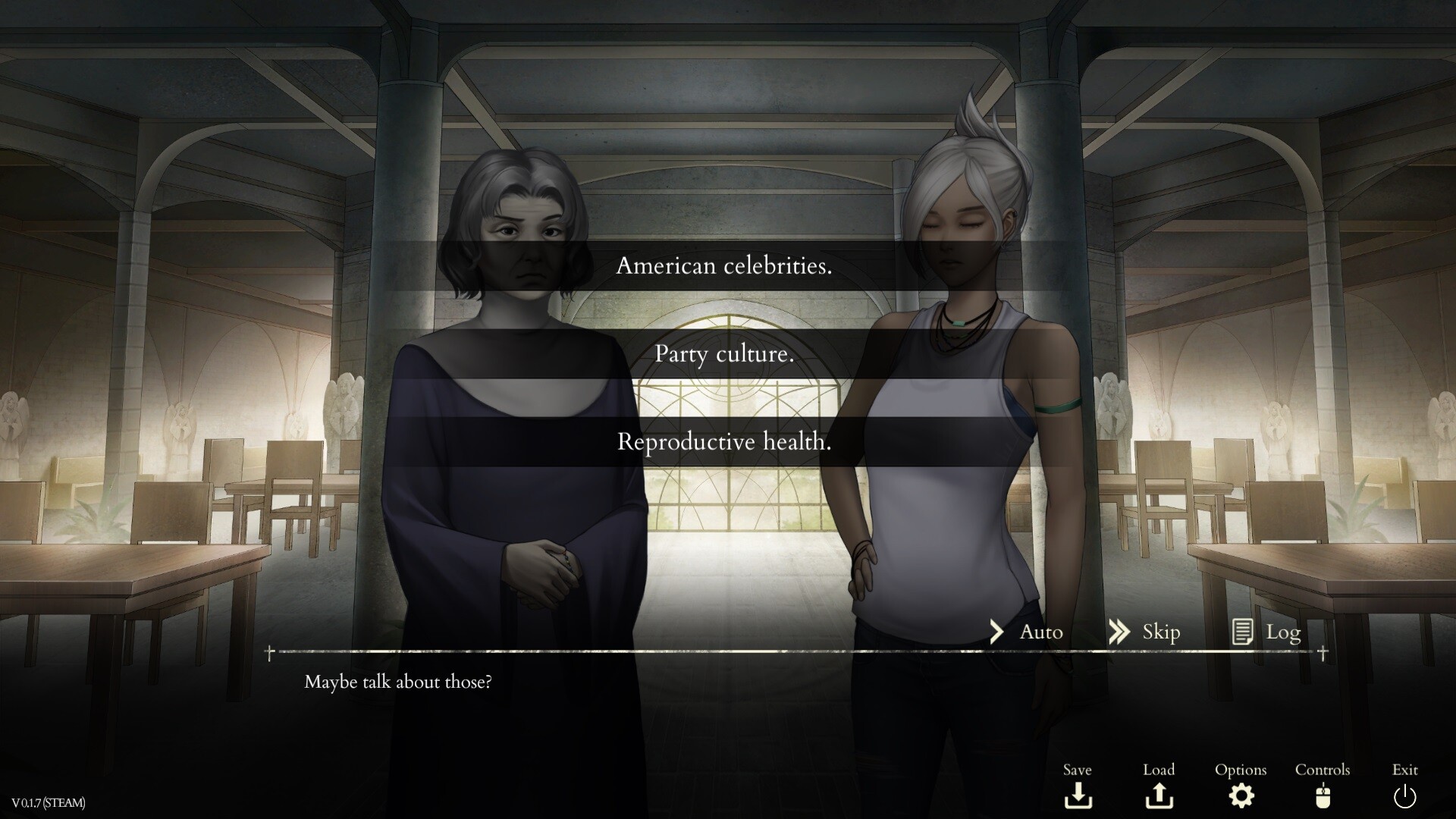
Interestingly, despite being an interactive experience, the game challenges the player’s sense of control early on, using said challenge as a narrative framing device for Holly’s struggles. At certain points in Saint Maker’s early chapters, the player, representing Holly’s consciousness and/or thought process, is presented with multiple choices on what they think Holly should do. However, no matter which choice they pick, Holly will override them and instead opt to stay within her proverbial safety bubble where she doesn’t have to risk upsetting others or confronting the true cause of her grief.
When Saint Maker was first released, some players criticized these moments where Holly overrides the player, expressing frustration that their choices “don’t matter.” However, in another light, these override moments could be seen as Holly’s sub-conscious attempts to advocate for herself, to show that the player doesn’t always know what’s best for Holly, Holly knows what’s best for Holly (even when she’s making a seemingly “wrong” or “bad” decision).
That can be one of the hardest parts of supporting a domestic violence survivor, but also one of the most critical. No matter how tempting it can be, especially when you see a loved one in pain, giving a survivor advice they didn’t ask for is the wrong approach to take.
It’s a lesson that people like Sister Adira, or the nuns of Saint Idelora’s, or Holly’s and Liana’s mother sadly never learned: thinking you know best isn’t an avenue towards helping people, it’s an avenue towards controlling (and potentially abusing) them.
In their Saint Maker review, The Gaming Outsider uses an apt sub-header in their review language: “Humans are scarier than ghosts.” It’s a good line, and it further hints at the underlying messaging lurking beneath Saint Maker’s more overt horror components.
Abusers don’t start off being abusive. More often than not, they’re people who once showed us love and kindness, and they use that seemingly mutual bond of love and caring to further tighten their sense of control. The mask of love and caring that they wear can be intoxicating for the person they’re targeting with their abuse, but once the mask slips, the “loving” environment the abuser has cultivated can quickly start to feel like a horror movie (or a horror game in this case).
We may not all have a tough-as-nails friend like Gabby Rivera in our corner, but when an abuse survivor decides it’s time to break the cycle of control they’re trapped in, having the support of others (a role REACH’s advocates are happy to fill) can make all the difference. In the meantime, the best way an outside observer can help is by being there to listen when it’s needed, and to provide help when it’s asked for.
